
The Treasury Inspector General for Tax Administration (TIGTA), the independent oversight body within the US Department of the Treasury tasked with providing oversight of the Internal Revenue Service's (IRS) activities, released its July 2025 snapshot report (the TIGTA Report) on the sweeping IRS workforce reductions—a change set to reshape how the nation's tax agency operates.
The report offers insight about just how sweeping these cuts were and which business units were most impacted. This post will highlight several key statistics and the resulting analysis conducted by TIGTA.
Why Did the IRS Cut Its Workforce?
The IRS began 2025 with approximately 103,000 full time staff. In January 2025, a series of presidential executive orders and guidance from the Office of Personnel Management (OPM) called for major downsizing of the federal workforce.
The IRS responded in February 2025, with four voluntary programs aimed at reducing its staff:
- Deferred Resignation Programs (DRP): This program allowed employees to resign but keep pay and benefits through Sept. 30, 2025, or later for those eligible to retire by year end.
- Treasury Deferred Resignation Program (TDRP): An expanded, agency-wide offer with similar incentives to the DRP for additional staff.
- Voluntary Early Retirement Authority (VERA): A program allowing eligible employees retire earlier than usual.
- Voluntary Separation Incentive Payment (VSIP): The IRS offered certain employees the option of accepting a “buyout” of up to $25,000 to resign or retire.
These programs ended on or about July 15. Collectively, these four programs appear to have failed to meet their target staff reduction numbers.
By the Numbers: Scope of the Cuts
- 25,386 employees have since separated, taken a DRP offer, or used another incentive to leave since January 2025.
- 294 more employees were sent termination notices as part of RIF actions.
- According to the TIGTA Report, these programs resulted in a 25% reduction of the total IRS workforce as of May 2025.
Some of these departures are still pending finalization due to ongoing court challenges and administrative leave statuses.
Breakdown by Program
- DRP: 4,575 employees are on paid administrative leave, set to resign by fall.
- TDRP: 17,071 employees were approved for separation, including many using VERA for early retirement.
- VSIP: 776 employees took buyouts.
- Other separations: 3,093 employees left due to resignation, retirement or termination outside formal programs.
Which Employees and Offices Were Hit Hardest?
Certain roles and business units felt an outsize impact:
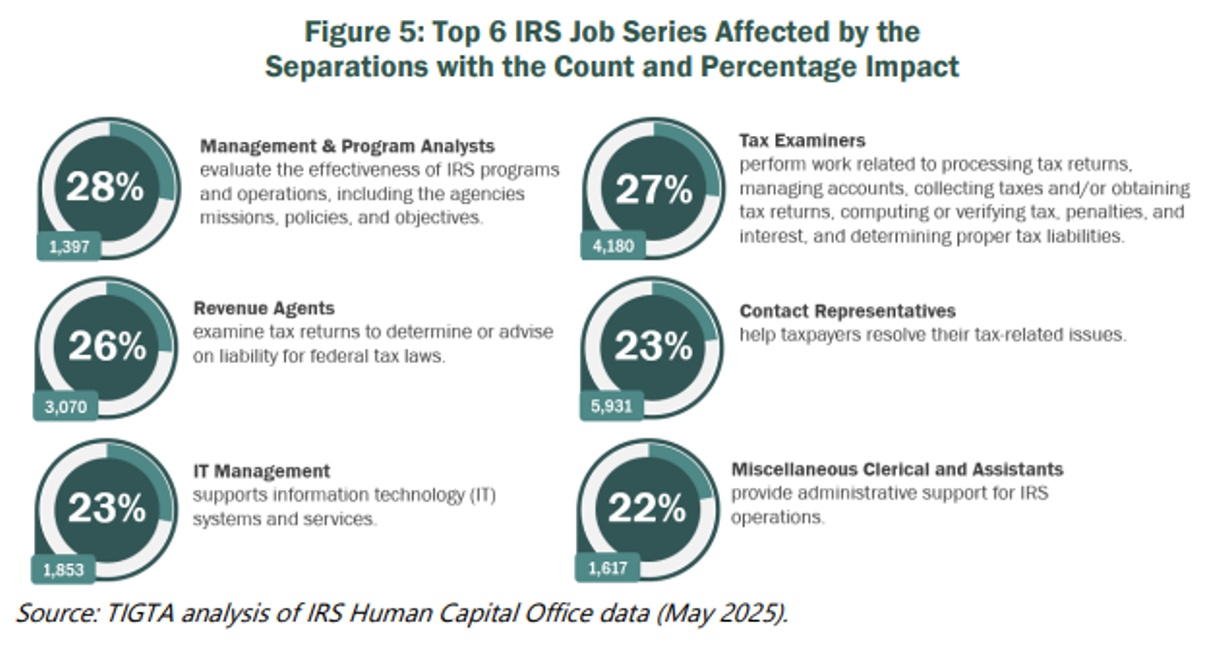
- 27% of Tax Examiners (those who review and process federal tax returns) separated.
- 26% of Revenue Agents (auditors who examine individuals and businesses) left.
- Business units like Contact Representatives (23% loss), IT Management (23%), and Clerks/Assistants (22%) were also deeply affected.
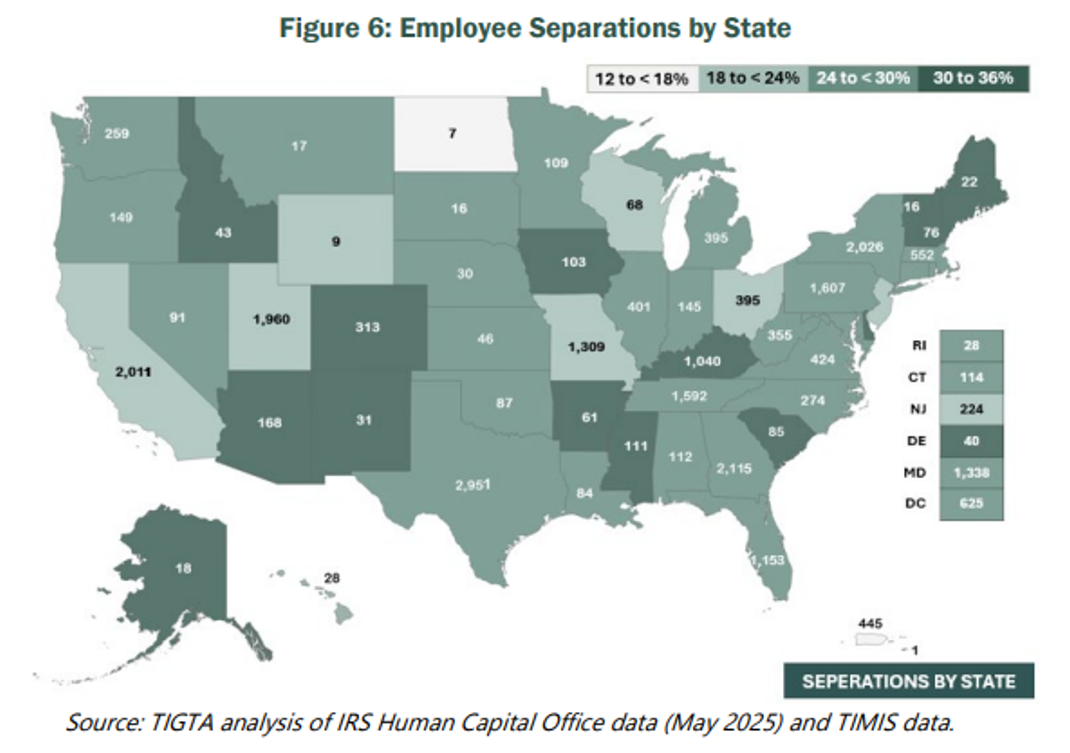
The cuts were not evenly distributed. States such as California, Georgia, New York, Texas and Utah saw the highest total separations. Meanwhile, Delaware, Idaho, Iowa, Maine and Mississippi experienced the largest percentage reductions relative to their IRS workforces.
Involuntary Separations: RIFs and Court Battles
When the voluntary departure programs failed to meet their staff reduction targets, the IRS initiated involuntary Reduction in Force (RIF) actions in April 2025 by issuing termination notices to hundreds more employees.
RIF actions targeted:
- Office of Civil Rights and Compliance: 179 notices, 75% downsizing.
- Taxpayer Experience Office: 106 notices; entire office eliminated.
- Taxpayer Service’s Office of Equity, Diversity, and Inclusion: 9 employees targeted.
These reductions were successfully challenged in federal district court which issued a preliminary injunction to pause the pending RIF actions. This injunction was lifted by the U.S. Supreme Court in July 2025.
As of May 2025, no staff have been terminated as a result of the RIF. But uncertainty remains as to what will come next, especially for probationary employees—some of whom were fired, then reinstated, and now await potentially renewed RIF actions.
What Does This Mean for Taxpayers?
The Taxpayer Advocate Service (TAS), an independent organization within the IRS that helps taxpayers navigate tax issues and ensures they are treated fairly, has sounded alarms related to the current status and composition of the IRS.
According to TAS, the IRS risks falling short on core tasks without a sufficient workforce —from programming tax processing systems and disseminating guidance to answering phones and timely processing returns. Without rapid improvements in technology, Americans could see a rockier filing season as soon as 2026.
As this new IRS era begins, a central question remains: Will fewer employees and the pursuit of greater efficiency lead to better outcomes—or new headaches—for the nation’s tax agency and the millions of taxpayers it serves?


 Senior Attorney
Joseph A. Peterson leads Plunkett Cooney’s Tax Law Practice Group and is a member of the firm’s Business Transactions & Planning Practice Group, where he counsels businesses, individuals and nonprofit organizations on a range ...
Add a comment

Topics
- Tax Law
- Personal Tax Controversy
- Business Tax Controversy
- Income Tax
- Tax Audit
- Probate Litigation
- Trust & Estate Planning
- Tax Lien
- Tax Discharge
- Property tax
- Business Risk Management
- Nonprofit
- Business Succession
- Tariffs
- Probate Administration
- Estate Administration
- Bankruptcy
- Charitable Giving
- Philanthropy
- Internal Revenue Service (IRS)
- Appellate Law
- Cryptocurrency
- Real Estate
Recent Updates
- A Tax Notice Is Not Always a Bill: How Taxpayers Should Triage an IRS Notice
- Hiring a “Tax Relief” Company? Ask Who Will Actually Handle Your IRS or State Tax Case
- Deciphering When an IRS Notice Means ‘More Than You Owe’
- When Baby Birds Leave the Nest: What Every Parent Needs to Know Before College Move-In Day
- IRS Simplifies Penalty Relief with New Automatic Process
- Advanced IRS Penalty Relief Strategies for Closely Held Businesses
- What We Know So Far About Michigan’s Proposed Service Tax Backfill Bill HB 5880
- How to Establish a 501(c)(3) with the IRS – A Practical Guide for Founders and Businesses
- What You Need to Know About COVID-Era Penalty Relief After Abdo and Kwong
- Tariff Refunds: What’s Happening Now and How Importers Should Prepare
