
Earlier this month, the Michigan Occupational Safety & Health Administration (MIOSHA) announced a six-month extension of its previously issued COVID-19 Emergency Rules which, in pertinent part, require businesses to implement a policy prohibiting in-person work to the extent such work can feasibly be completed remotely.
For the past two weeks, numerous businesses have grappled with the effects of that extension and wondered when, if any time before September 2021, they could start to bring back employees who have been working remotely for over a year.
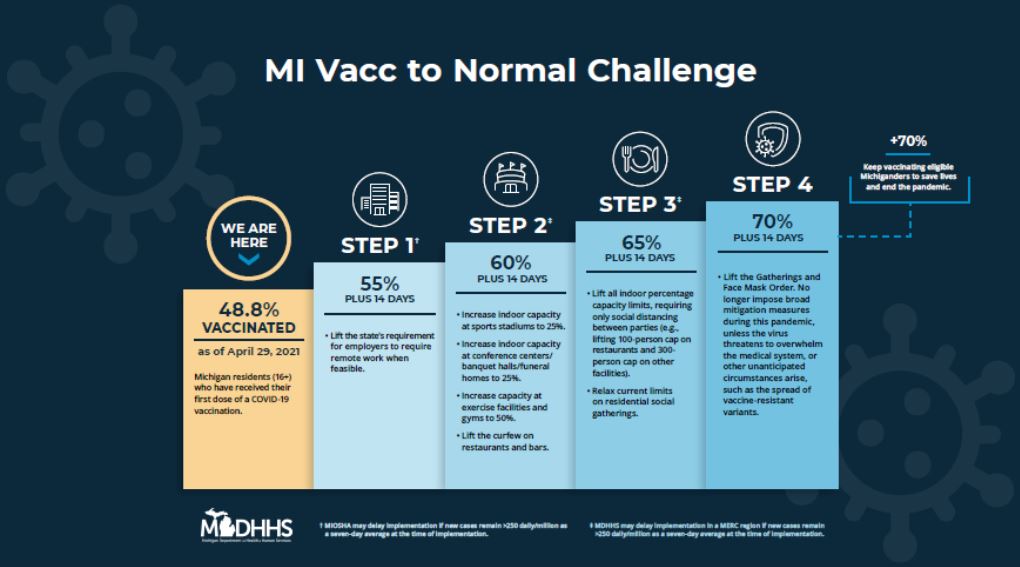
On April 29, Gov. Gretchen Whitmer unveiled the “MI Vacc to Normal” plan, which outlines four vaccination-based milestones to get the state back to normal and provides the proverbial “light at the end of the tunnel” for Michigan businesses.
Simply put, the more people that are vaccinated, the more people can return to normal activities, which will be allowed by meeting specific statewide vaccination rates.
Michiganders will be allowed to return to activities according to the following vaccination milestones:
Two weeks after 55% of Michiganders (4,453,304 residents) are fully vaccinated
- Allows in-person work for all sectors of business.
Two weeks after 60% of Michiganders (4,858,150 residents) are fully vaccinated
- Increases indoor capacity at sports stadiums to 25%.
- Increases indoor capacity at conference centers/banquet halls/funeral homes to 25%.
- Increases capacity at exercise facilities and gyms to 50%.
- Lifts the curfew on restaurants and bars.
Two weeks after 65% of Michiganders (5,262,996 residents) are fully vaccinated
- Lifts all indoor % capacity limits, requiring only social distancing between parties.
- Further relaxes limits on residential social gatherings.
Two weeks after 70% of Michiganders (5,667,842 residents) are fully vaccinated
Lifts the Gatherings and Face Masks Order such that MDHHS will no longer employ broad mitigation measures unless unanticipated circumstances arise, such as the spread of vaccine-resistant variants.
To date 48.8% of Michiganders have received at least one does and 35.9% of Michiganders are fully vaccinated. It is anticipated that Michigan will reach the critical 55% vaccinated mark within the next seven (7) to 10 days, which means businesses may be cleared for in-person work by the end of May, 2021.


Add a comment
Topics
- Employment Liability
- Labor Law
- Department of Labor (DOL)
- Fair Labor Standards Act (FLSA)
- Employment Discrimination
- Workplace Harassment
- Employment Agreement
- Hostile Work Environment
- Equal Employment Opportunity Commission (EEOC)
- Human Resources
- Wage & Hour
- Family Medical Leave Act (FMLA)
- National Labor Relations Act
- Minimum Wage
- At Will Employment
- COVID-19
- Alternative Dispute Resolution (ADR)
- Coronavirus
- National Labor Relations Board
- Americans With Disabilities Act (ADA)
- Noncompete Agreements
- No Tax on Overtime
- Overtime
- Payroll
- National Labor Relations Board (NLRB)
- Arbitration
- Whistleblower Protection Act
- Regulatory Law
- Title VII
- Civil Rights
- Paid Medical Leave Act (PMLA)
- Contract Employees
- Sick Leave
- Tax Law
- Retaliation
- Transgender Issues
- OSHA Issues
- Earned Sick Time
- Contracts
- Unemployment Benefits
- Business Risk Management
- Federal Trade Commission
- Civil Litigation
- Settlements
- ERISA
- Workers' Compensation
- Accommodations
- Cannabis
- Public Education
- LGBTQ
- Class Actions
- Department of Justice
- Medicare Issues
- Sexual Harassment
- Garnishments
- Social Media
- Retail Liability
- RICO
- Emergency Information
- Uniformed Services Employment and Reemployment Rights Act (USERRA)
- Department of Education (DOE)
- Title IX
- Medical Marijuana
- Right to Work
- Union Organizing & Relations
Recent Updates
- Sixth Circuit Reinforces Value of Prompt Employer Action in Harassment and Retaliation Claims
- Department of Labor Proposes Rule Altering Joint Employer Analysis
- Federal Policy Favors Arbitration but Poor Drafting Derails Enforcement
- An Employers Guide to New OBBBA Overtime Reporting Requirements
- Federal Court Rules State Discrimination Claims Subject to Mandatory Arbitration
- Are Boilerplate Terms in Employment Applications Enforceable?
- Is Your Business Ready for Pay Transparency Laws?
- Supreme Court Resolves Circuit Split in Reverse Discrimination Cases
- Michigan Legislature Avoids Chaos by Amending Earned Sick Time Act Just Prior to Deadline
- Implementing the Pregnant Workers Fairness Act: Key Insights for Employers