
Picture this. A hunter’s treestand gives way after three seasons of deferred maintenance. A crossbow fires when a user's hand drifts into the rail path. A revolver discharges under conditions the manufacturer never designed for.
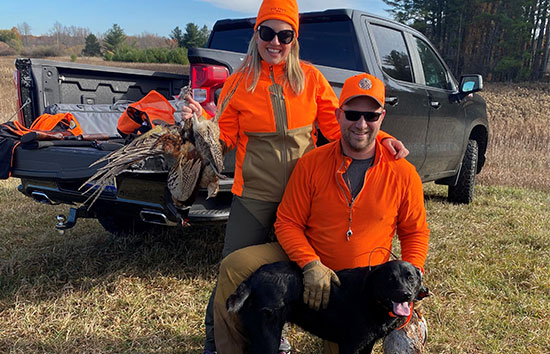
shows offer her prize pheasant during a hunt with
husband, Will, and their dog, Koda.
Within hours, the physical evidence that will make or break your defense is scattered across a muddy hillside, an emergency room or a game warden’s truck.
Welcome to hunting products liability defense! Where the stakes are high and the window is narrow.
Hunting products occupy a unique space in products liability litigation. Unlike a toaster sitting on a kitchen counter, these products live hard lives – exposed to rain, ice, UV and temperature extremes. They’re handled by first responders who aren’t thinking about evidence preservation. They’re left in trees for months between uses. They’re stored in barns alongside rodents and moisture. And when an incident occurs, well-meaning family members, hunting buddies and emergency personnel often do more damage to your evidence than the incident itself.
The first 72 hours after you receive incident notice can determine whether you’re building a winning defense or playing catch-up for the next few years. Protocol isn’t just housekeeping. It’s litigation strategy. Think of this as your pre-season scouting report for litigation. Preparation wins cases.
Below are three key areas manufacturers, insurers and their legal defense teams would do well to consider:
1. Preserve Evidence Immediately (And Comprehensively!)
The moment an incident is reported, your preservation instincts need to kick in like a retriever on a downed bird. Secure everything. Not just the product. Think of every associated component, in a secure, climate-controlled, unaltered state.
Why “Comprehensive” Isn’t Optional:
Root cause in hunting product cases frequently traces to a secondary component the plaintiff conveniently forgets to mention. The strap that wasn’t the strap that broke. The ammunition that wasn’t factory-loaded. The aftermarket modification nobody disclosed. If you don’t have it in your possession, you can’t prove it was the problem.
Firearms
- Secure: The weapon, ALL ammunition (spent and unspent casings), holster, lights, lasers, optics, magazines and every aftermarket modification
- Why it Matters: In some firearms cases, the defense can hinge on proving the revolver was designed and manufactured properly, and that the plaintiff’s use of reloaded ammunition was the culprit. You can’t make that argument without the ammo.
Treestands
- Secure: Platform, ALL straps, ratchets, chains, ropes, cables, full-body harness, carabiners, tether lines, lineman’s belts, climbing sticks/steps and all installation hardware
- Critical Tip: Retain every strap even if it appears undamaged. Root cause often traces to user wear patterns, improper installation or a secondary component. The strap that “looked fine” to a family member may show three years of UV degradation under a microscope.
Crossbows
- Secure: Frame, limbs, string, cables, serving, cocking mechanism, finger guards and safety devices, bolts/arrows, broadheads, scope/sight, rail and any aftermarket trigger or safety modifications
- Critical Tip: In hand-placement injuries, preserving the finger guard, fore-grip and rail configuration is essential to demonstrating that the product provided adequate protection when used as instructed.
2. Document the Chain of Custody with Precision
Evidence that’s been through six pairs of hands without documentation is evidence your opponent will attack. Track every person who touches the product from the moment the incident is reported.
In hunting product cases, the chain is often longer and messier than you’d expect. Think about who typically handles this evidence before it reaches you:
- Law enforcement officers at the scene
- Game wardens conducting their own investigation
- Ambulance and hospital staff (especially for treestand falls)
- Hunting companions who “helped” cut a harness off during rescue
- Insurance adjusters
- Multiple attorneys as the case develops
3. Propose and Conduct Joint Inspections
Here’s your best shield against spoliation accusations: invite plaintiff’s experts to every inspection. Joint inspections aren’t just good practice, they’re litigation armor. When opposing counsel can’t claim you tested in secret, tampered with evidence or destroyed something inconvenient, your results carry maximum weight.
Model protocol elements to include:
- Verification procedures before any handling begins
- Non-destructive examination first: measurement, photography, CT scanning
- No testing without advance notice, announced function checks only
- Component disassembly with all parties observing
- Scene inspection provisions (critical - see below)
- Data sharing: digital images, SEM images, hardness data, chemical analysis results
- Agreement and signature blocks from all parties
Scene Inspections: You Need to See the Tree!
For treestand and climbing equipment cases, a scene inspection isn’t optional, it’s where cases are won. Many alleged “defects” evaporate the moment you document the actual installation conditions.
Your protocol must require:
- Plaintiff attendance or, at minimum, marking the exact tree with flagging tape and GPS coordinates
- Full tree documentation: species, diameter at attachment point, bark condition, rot or insect damage, lean angle, evidence of prior stand attachment (screw holes, strap marks, bark scarring)
- Terrain photography: slope grade, ground composition, distance from base to landing point, obstructions
- Attachment height measurement – critical for demonstrating user-installation failures (improper heights, unsuitable trees, non-manufacturer hardware)
- Weather and environmental conditions between incident and inspection dates
- No deviation without agreement by all parties; no functioning of any assembly without advance notice
Many “defective treestand” claims are actually “user attached product to a dying oak at an improper height using third-party hardware” claims. The scene tells that story – if you get there.
Don’t Let the Trail Go Cold
Done right, your protocol becomes the framework for affirmatively proving that the product performed exactly as designed, and that the incident resulted from user conduct, not product defect.
And this is just the trailhead. In the field, preparation separates a successful hunt from a wasted trip. In litigation, it separates a defensible case from an indefensible one. Scout your evidence early, set up in the right position and don’t let the trail go cold!


 Partner
Ellisse S. Thompson is a partner in Plunkett Cooney’s Torts & Litigation Practice Group, where she focuses her practice on complex product liability, premises liability and general liability matters.
A senior attorney in the ...
Add a comment
Topics
- Civil Litigation
- Litigation Discovery
- Product Liability
- Premises Liability
- Property Liability
- Consumer Liability
- Consumer Protection
- Food Law
- Foodservice & Hospitality
- Retail Liability
- Negligence
- Insurance
- Residential Liability
- Fire Claims
- Appellate Law
- Contractor Liability
- General Liability
- Damages Recovery
- Construction Contractors
- Construction Law
- Commercial Real Estate
- Commercial Liability
- Motor Vehicle Liability
- Water Loss Claims
- Snow & Ice Claims
- Open & Obvious Doctrine
- insurance policy
- Personal Injury
- Fraud Activity
- Investigations
- Governmental Immunity
- Contracts
- Traumatic Brain Injury
- Risk Management
- Open & Obvious
- Business Risk Management
- Marine Liability
- Maritime Law
- Artificial Intelligence
- Liquor Liability
- Design Defect
- Industrial Liability
- Lost Earnings
- Video Recording
- Defamation
- Professional Liability
- Independent Medical Examinations (IME)
- Sports-liability
- Alternative Dispute Resolution (ADR)
- Auto Liability
- Bankruptcy
- Intoxication
- Judicial Estoppel
- No Fault Liability
- Trucking Liability
- Wrongful Death
- FDA Regulations
- Real Estate
- Regulatory Law
- Constructive Notice
Recent Updates
- Don’t Spook the Evidence: A Field Guide to Defending Hunting Product Claims
- If It Looks Like a Product Claim and Quacks Like a Product Claim, Michigan’s Innocent Retailer Statute Has You Covered
- Who is Left Holding the Bag When a Parasite Hits the Lettuce Supply Chain?
- Product Liability Risk Management for e-Bikes and Scooters
- The Missing Feature: When ‘Doing Nothing’ Becomes the Product Liability Theory
- America’s 250th Birthday Celebration Poses Old and New Products Liability Risks
- Is Social Media the Next Frontier in Products Liability Defense?
- Spring Cleaning – Know Your Duties With Snow, Ice Liability
- What damages are recoverable in Michigan when property is negligently damaged or destroyed?
- Businesses can Bolster Lack of Notice Defense by Documenting Premises Inspections
